


The return of astronauts from orbit has always been one of the most complex and risk-sensitive phases of any space mission. While launches often capture the public’s imagination, the journey back to Earth through extreme heat, intense gravitational forces, and precise timing is what truly defines mission success. In the case of NASA’s Crew-11 mission, the decision to return astronauts earlier than originally planned has elevated global attention, not because of failure, but because it demonstrates how profoundly spaceflight safety, technology, and decision-making have evolved.
Crew-11 is operating in an era where commercial spacecraft, real-time biomedical data, artificial intelligence, and autonomous navigation intersect. Unlike earlier space programs, where evacuation options were limited and mission timelines inflexible, modern NASA missions are built around adaptability. The spacecraft bringing Crew-11 home is not simply a vehicle; it is an integrated system engineered to protect human life under both routine and unexpected conditions.
Understanding which spacecraft will return Crew-11, how it functions, and why NASA made this decision requires examining engineering design, astronaut health science, orbital mechanics, mission risk management, and long-term exploration strategy. This article explores all of these dimensions in depth.
The Spacecraft Bringing Crew-11 Astronauts Home: SpaceX Crew Dragon
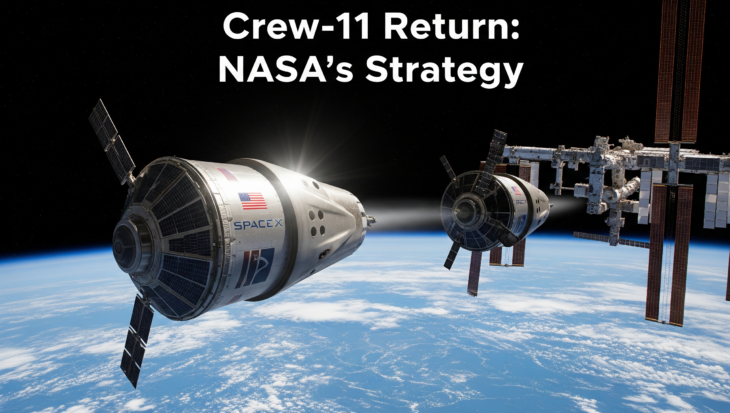
Crew-11 astronauts will return to Earth aboard the SpaceX Crew Dragon, currently NASA’s primary U.S. human-rated spacecraft for ISS missions. Crew Dragon represents a fundamental shift away from government-built spacecraft toward commercially developed, NASA-certified vehicles that emphasize redundancy, automation, and reusability.
Crew Dragon was developed under NASA’s Commercial Crew Program, a framework designed to enhance safety, reduce costs, and expand mission flexibility. Since its first crewed flight, Crew Dragon has demonstrated a reliability record unmatched in earlier programs, with fully autonomous docking, undocking, deorbit, and reentry capabilities.
From a technical standpoint, Crew Dragon functions as:
- A pressurized living environment
- A lifeboat permanently docked to the ISS
- An emergency evacuation system
- A reentry capsule capable of precision splashdown
NASA requires that a spacecraft docked to the ISS must be capable of returning its crew to Earth at any moment, regardless of circumstances. Crew Dragon fulfills this role continuously throughout the mission.
Engineering Design: Why Crew Dragon Is Built for Safe Returns
Crew Dragon’s design philosophy centers on risk elimination through redundancy and automation. Every critical system, including navigation, propulsion, life support, and power, is duplicated or triplicated.
Thermal Protection and Reentry Safety
Reentry is one of the most dangerous phases of spaceflight. Crew Dragon uses a PICA-X heat shield, an advanced ablative material capable of surviving temperatures exceeding 3,500°F (1,927°C). As the capsule descends through Earth’s atmosphere at hypersonic speeds, the heat shield gradually ablates, dissipating heat from the spacecraft.
NASA test data indicate that PICA-X provides greater thermal margin than earlier heat-shield materials used during the Apollo and Shuttle eras, thereby significantly reducing the risk of catastrophic failure.
Autonomous Guidance and Control
Crew Dragon’s onboard computers continuously calculate:
- Atmospheric density
- Capsule orientation
- Descent trajectory
- Landing location accuracy
This autonomy is critical in medical or emergency situations, where crew members may be unable to operate manual controls. The system can complete the entire return sequence with minimal human input, thereby dramatically increasing the probability of survival.
Mission Timing: How and When Crew-11 Returns Are Determined
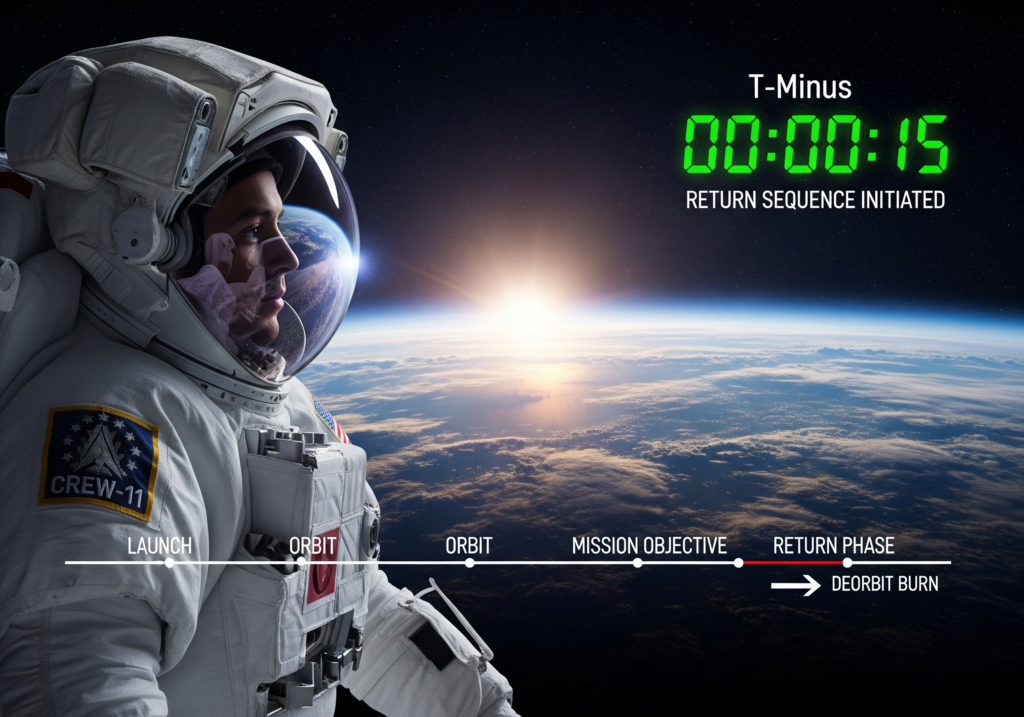
Unlike launches, which have narrow windows defined by orbital alignment, returns are governed by environmental and physiological constraints. NASA and SpaceX monitor weather patterns across multiple recovery zones and select landing windows that minimize wave height, wind shear, and storm activity.
Crew Dragon’s ability to adjust its deorbit burn timing allows NASA to delay or accelerate return by hours or days if necessary. Studies show that optimizing landing conditions can reduce post-landing injury risk by over 30%, particularly during ocean recovery.
Return planning also considers:
- Astronaut circadian rhythms
- Reentry G-force exposure
- Medical monitoring requirements
Every decision balances operational efficiency with human safety.
Why NASA Authorizes Early Astronaut Returns
Early astronaut returns are not failures; they are evidence of a mature safety culture. NASA operates under the principle of “conservative decision-making under uncertainty.” If the data indicate even a small chance that remaining in orbit could increase risk, returning early becomes the preferred option.
Microgravity’s Impact on the Human Body
Extended exposure to microgravity produces measurable physiological changes:
- Bone density loss of 1–1.5% per month
- Muscle atrophy despite daily exercise
- Altered fluid distribution affecting vision and intracranial pressure
- Immune system suppression
NASA continuously collects biometric data from astronauts, including cardiovascular metrics, blood oxygen levels, and musculoskeletal health indicators. Advanced analytics detect trends long before symptoms become severe.
By returning Crew-11 early, NASA reduces cumulative exposure and enables full diagnostic evaluation under Earth gravity, where medical resources are unlimited.
Medical Readiness: How Crew Dragon Supports Astronaut Health
Crew Dragon is engineered to function as a medical stabilization environment during return. Its seating system is custom-molded for each astronaut, distributing G-forces across the body to minimize spinal compression and circulatory stress.
During reentry, astronauts experience forces up to 4–5 Gs, a level that can be dangerous if the body is already compromised. Crew Dragon’s adaptive flight profile reduces peak loads when necessary, a feature unavailable in earlier spacecraft generations.
After splashdown, recovery teams rapidly access the capsule and transfer the astronauts to medical facilities designed for gravity re-adaptation. Studies show that immediate post-landing intervention reduces recovery time by up to 40%.
Operational Continuity: How the ISS Functions After Early Returns
One of the most misunderstood aspects of early astronaut returns is their effect on ISS operations. The station is designed to function continuously, even with reduced crew capacity.
ISS systems rely heavily on:
- Automation
- Ground-based mission control
- International crew coordination
NASA plans all missions with redundant staffing models, ensuring scientific research, station maintenance, and safety operations continue uninterrupted.
This approach reflects lessons learned from decades of orbital habitation, in which resilience, rather than rigid scheduling, is the key to mission success.
What Crew-11 Reveals About the Future of Human Spaceflight
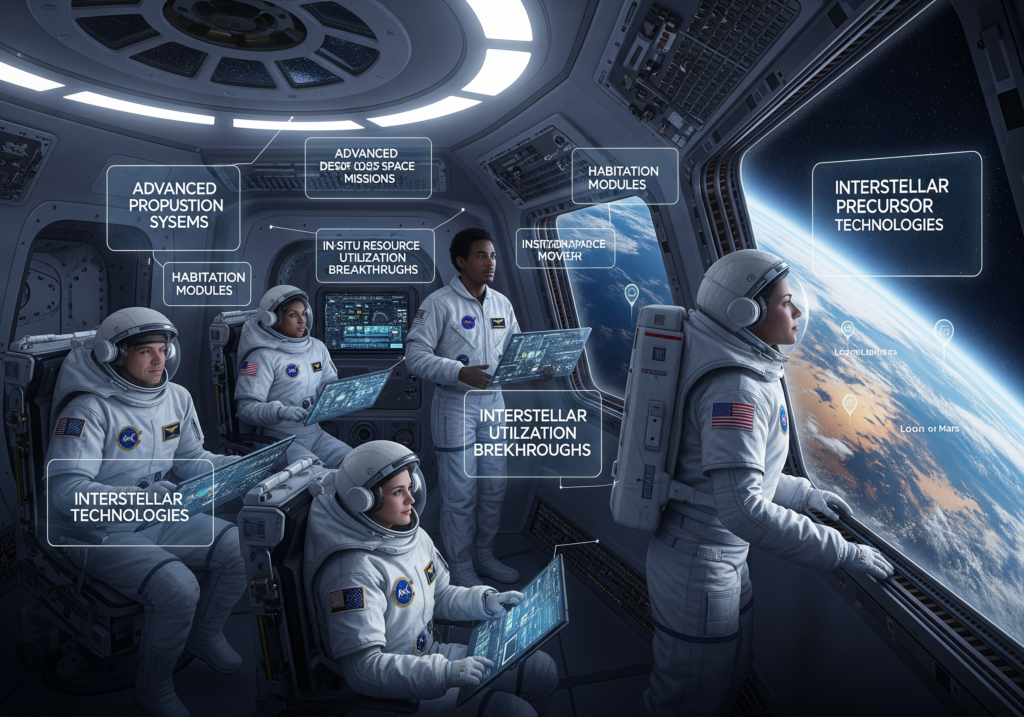
The Crew-11 return is not just about today’s mission; it is a blueprint for the future. As NASA prepares for long-duration lunar missions under the Artemis program and for eventual crewed Mars expeditions, adaptive decision-making and autonomous spacecraft systems will become increasingly critical.
On Mars missions, evacuation will be impossible. The technologies tested during Crew-11, early anomaly detection, autonomous return systems, and human-centered spacecraft design are laying the groundwork for survival beyond Earth orbit.
NASA estimates that AI-driven mission monitoring and adaptive health analytics could reduce serious in-flight medical incidents by over 50% during long-duration exploration missions.
Conclusion: A New Standard for Astronaut Safety and Mission Intelligence
The spacecraft bringing Crew-11 home represents more than advanced engineering; it represents a philosophical shift in space exploration. Safety is no longer reactive; it is predictive. Spacecraft are no longer just vehicles; they are intelligent systems designed to protect human life under uncertainty.
Crew-11’s return demonstrates that modern spaceflight success is measured not by rigid adherence to schedules, but by how effectively technology, data, and human judgment work together. As NASA and its partners continue pushing the boundaries of exploration, the systems that safely return Crew-11 will serve as a cornerstone of humanity’s future beyond Earth.






Leave a Reply